


Hi-Fi Tuning and Sound Optimization with Synergistic Research: The Complete Guide to Hi-Fi Accessories


In this blog, we would like to take a closer look at the world of Hi-Fi tuning.
You quickly notice that the moment you start exploring all the small gadgets and accessories available, the market becomes incredibly diverse. There are countless approaches within the Hi-Fi tuning community, and not every concept works equally well in every audio system.
Alongside all the individual preferences and carefully selected components, every Hi-Fi system is essentially a conglomerate of audiophile equipment, cables, power connections, room acoustics and peripheral accessories.
The way each listener puts these elements together reveals just how much individuality and personal taste are part of the Hi-Fi experience. We find this fascinating time and time again.
In this guide, we would like to focus specifically on Hi-Fi tuning with Synergistic Research components and accessories.
Why We Focus on Synergistic Research
Why such a focused approach?
Well, we have tried many different brands and approaches in the field of Hi-Fi tuning. Some products made a lasting impression right from the start, while others turned out to be a step in the wrong direction or simply did not suit our taste.
That is an important aspect of Hi-Fi tuning: Not every product creates the same result in every system. A component that brings more clarity and openness to one setup may sound too bright or overly analytical in another.
For us, the key is therefore not to follow every trend blindly, but to listen carefully and understand how a particular product interacts with the rest of the system.
Synergistic Research is especially interesting to us because the company does not focus on just one isolated aspect of system optimization. Its UEF approach covers several areas, including EMI/RFI control, mechanical resonance control, cables, power accessories and room acoustics. Synergistic Research itself presents UEF as a broader product ecosystem for components, cables, the overall system and the listening room.
This system-oriented approach is exactly what we find so interesting.
What Is Hi-Fi Tuning?
The Hi-Fi System as an Ecosystem
If you look at a Hi-Fi system as a whole, it can be compared to an ecosystem in which all components constantly interact with one another.
Unfortunately, this interaction does not always work in a positive way. Depending on the equipment, the room, the power supply, the cabling and the installation, these interactions can also contribute to a less focused, less coherent or less involving sound.
The interaction between the individual Hi-Fi components takes place through the power supply, digital and analogue interconnects, speaker cables and the mechanical environment in which the equipment is installed.
All of these elements form part of a larger system. Each component contributes its own electrical, mechanical and electromagnetic characteristics.
We explain how copper and silver cables differ in their interaction with electromagnetic fields in our article Silver vs. Copper Hi-Fi Speaker Cables.
Electromagnetic Interference in Modern Audio Systems
Hi-Fi equipment housings and chassis can be affected by static charge, EMI/RFI and other electromagnetic influences, even when the components are designed and protected against interference as effectively as possible.
The challenge today is not necessarily that electromagnetic compatibility regulations have become less demanding. In many respects, standards and testing requirements have become more comprehensive over the years.
The real challenge is that we now live in a much more technologically saturated environment. Wi-Fi routers, switching power supplies, mobile communication, computers, smart-home devices and wireless equipment are present in almost every modern household.
This means that today’s Hi-Fi systems often operate in a much denser electromagnetic environment than comparable systems did several decades ago.
We have taken a closer look at how such interference fields can affect individual components, including audiophile fuses, in our detailed article: Do Audiophile Audio Fuses Make a Difference?
Modern audio equipment also offers considerably more functions and connectivity. Network streaming, USB, Bluetooth, Wi-Fi, digital inputs and switching power supplies all provide additional possibilities, but they can also introduce additional points at which interference may become relevant. A considered grounding concept can be another useful approach to dealing with these internal and external interference fields.
Grounding is not simply about connecting every component to earth and hoping that all unwanted noise disappears. In a complex Hi-Fi system, the individual grounding paths, chassis, cable shields, power supplies and signal connections interact with one another.
If several components are connected to ground through different paths, unwanted circulating currents can occur.
These ground loops may then become audible as hum, buzz or a less quiet background.
The real art is therefore not to create as many ground connections as possible, but to create the right ones in the right places.
This can be particularly relevant in systems with several components, external power supplies, network equipment, long cable runs or a combination of balanced and unbalanced connections.
High-quality grounding cables and carefully planned grounding solutions can help to influence this electromagnetic environment in a more controlled way.
They are not a replacement for protective earth or for any safety-related electrical connection. Instead, they form part of a broader Hi-Fi tuning approach that looks at the complete system rather than at individual components in isolation.
We have taken a closer look at grounding concepts and high-end grounding cables in our article High-End Hi-Fi Grounding Cables for Audio Systems: Improve Sound Quality and Safety
Analogue, CD or Streaming?
Depending on whether your system is primarily focused on analogue playback, vinyl, CD or music streaming, the starting point for Hi-Fi tuning may be different.
In an analogue system, the phono stage, turntable, tonearm wiring, grounding and mechanical isolation can be particularly important. In a CD or digital setup, the focus may shift towards the DAC, digital connections, power supplies, clocking and electromagnetic interference.
In a streaming system, the network infrastructure becomes part of the audio environment. Router, network switch, streamer, DC power supply, Ethernet cables, USB connections and DAC should therefore be considered as an interconnected chain.
This does not mean that every part of the system needs to be upgraded immediately. In fact, the opposite is usually more sensible.
The best approach is to look at your own setup and identify the point that appears to be the most sensitive or the most limiting. Where does the system sound unsettled? Where is the soundstage less coherent than it could be? Where might clarity, focus or spatial information still be missing?
That is often the best place to begin.
Hi-Fi Tuning Begins with the Cables
A natural starting point for Hi-Fi tuning is the optimization of both the signal paths and the power supply.
High-quality interconnects, speaker cables and power cables form the connections between the individual components of a Hi-Fi system. They are therefore already part of the broader Hi-Fi tuning concept.
This does not mean that every existing cable must immediately be replaced or that the most expensive cable is automatically the best choice.
It is often more useful to begin by organizing the cable layout properly, avoiding unnecessary parallel runs between power and signal cables, and choosing a combination of conductor design, shielding and connectors that suits the system.
Once again, every Hi-Fi system reacts differently.
What brings more calm, clarity and spatial structure to one setup may be too much in another. This is why we see high-quality cables not as isolated accessories, but as part of a complete Hi-Fi tuning and system-matching concept.
In addition to Synergistic Research, we also offer cables from Audiomica Laboratory and Grimm Audio.
Audiomica Laboratory represents a distinctly audiophile approach with different cable series for different systems and listening preferences. Grimm Audio, on the other hand, follows a more technical and studio-oriented philosophy, focusing on factors such as controlled geometry, low susceptibility to microphony and effective shielding. Grimm Audio describes its TPR and SQM cables in terms of professional signal transmission, shielding and reduced sensitivity to interference.
A detailed comparison of power cables and interconnects will be covered in a separate article. There, we will take a closer look at conductor materials, cable geometry, shielding, balanced and unbalanced signal transmission, and the differences between Hi-Fi and professional audio cables.

Targeted Hi-Fi Tuning with Synergistic Research ECTs and GCTs
The Synergistic Research ECTs, or Electronic Circuit Transducers, are among the smallest and, at the same time, most entertaining tuning tools in the range. The small modules can be positioned at various points throughout a system using the supplied adhesive putty or paste.
There is a guaranteed element of fun in finding the ideal placement. Possible starting points include a DAC, network switch, linear power supply, streamer, amplifier, CD transport or phono stage. Interesting changes can also occur when the ECTs are placed on power strips, routers or at specific points around the power supply.
This targeted approach is precisely what makes the ECTs so appealing. Instead of simply placing one large accessory in the system and waiting for the result, you work your way through the system step by step. Where are the critical points? Which component reacts most strongly? At which position does the sound change towards greater calm, clarity or spatial organization?
Even when a manufacturer does its best to shield the various circuit sections inside a component from one another, a Hi-Fi device remains the sum of its individual parts, circuits and mechanical properties. Internal interference can be reduced, but in a complex electronic device it can hardly be avoided completely.
This is exactly where the ECTs come in, following Synergistic Research’s approach. They are intended to influence the local electromagnetic environment of the respective component and, in doing so, contribute to a quieter noise floor and a clearer presentation. Synergistic Research places ECTs within the area of electromagnetic field control.
Depending on the device, its construction and your personal level of comfort, ECTs can also be used inside components. If you do not want to open a device, however, you can easily experiment with positioning the modules on the outside of the chassis or underneath the component at selected points.
Important: Opening power supplies, amplifiers or other Hi-Fi components should be carried out exclusively by qualified professionals. For a safe and straightforward introduction, external placement is therefore the recommended option.

The ECTs are our ultimate Hi-Fi tuning tip: With relatively little effort, there is a great deal to explore. And once you have started searching for the individual sweet spots in your system, these small devices can become surprisingly addictive.

The Synergistic Research GCTs, or Ground Circuit Transducers, follow a similar basic principle to the ECTs, but are aimed more specifically at the ground, grounding and circuit-reference areas of a component.
They are often positioned directly at selected power or connection points on the equipment. There, they are intended to influence the local electromagnetic environment and help reduce interference affecting the grounding paths and power supply.
On devices with a three-pole IEC power inlet, positioning the GCT at the rear of the component can be an interesting starting point. Devices with a two-pole power connection, on the other hand, do not have a protective earth connection. This makes such components particularly interesting candidates for targeted Ground Circuit Tuning for many users.

It is important to note that a GCT does not replace protective earthing or a standards-compliant electrical installation. It is passive, field-influencing tuning accessory, not a safety-related grounding device.
GCTs can also be interesting in the digital domain. In a streaming system, possible starting points include routers, network switches, DC power supplies and Ethernet connections. Especially when a system relies heavily on streaming, USB or network transmission, these areas should not be excluded from the Hi-Fi sound-tuning process from the outset.
As with the ECTs, not every component will react in the same way. We therefore recommend making only one change at a time, listening carefully and comparing the different positions with one another.
This principle of passive field tuning may already sound familiar if you've read our article Do Audiophile Fuses Make a Difference?, where we explain the electromagnetic fields forming around the AC power inlet. GCTs address exactly this bottleneck.
GCTs pursue a similar noise-reduction goal as dedicated grounding solutions, just applied passively at the power inlet rather than through a direct electrical connection. If you're also looking to optimise signal-path grounding, our Grounding Cables Guide covers dedicated high-end grounding cables in detail.

Not every Hi-Fi tuning measure takes place inside a component or directly on a cable. After all, a significant part of the sonic experience is created within the listening room itself.
Loudspeakers, walls, ceiling, floor and furnishings all form an acoustic environment in which sound waves spread, reflect and interact with one another.
The Synergistic Research HFTs, or High Frequency Transducers, operate precisely at this interface between loudspeaker and room. Synergistic Research describes them as acoustic transducers that can be positioned at defined points on the loudspeakers and throughout the listening room.
The HFTs can be positioned on the loudspeakers, on the wall behind them, on the side walls or on the ceiling. Finding the right placement requires a little patience and should not be approached according to the principle of “stick them on once and forget about them.”
That is also part of the appeal of this type of room tuning. Even small changes in position can influence the perception of the soundstage, spatial presentation and tonal balance. The sound may appear larger, deeper and more open, while the loudspeakers seem to disappear more effectively into the acoustic presentation.
The HFT Speaker Kit is therefore not a conventional absorber or diffuser system that changes the room on a large scale. Instead, it is a targeted acoustic tuning solution that can be adjusted step by step to suit your own listening preferences and the characteristics of the room.
The effect naturally depends on the room, the loudspeakers, their placement and your personal listening habits. That is precisely why it is worth experimenting with the different positions and allowing enough time to listen carefully.
With the HFT Speaker Kit Mk II, Synergistic Research combines six differently tuned HFT types in an asymmetric placement concept. The manufacturer recommends beginning with the standard HFTs, then adding the HFT 2.0 units for warmth, HFT X units for clarity and focus, and HFT Wide Angle units for greater width and scale.

Another option for targeted Hi-Fi tuning is provided by the Synergistic Research UEF Performance Enhancers. They are available for different interfaces and signal areas, including USB, LAN or RJ45, XLR and RCA/Cinch.
The small modules are inserted directly into suitable inputs, outputs or unused connections on the respective component. Possible applications include a streamer, network switch, router, USB DAC, phono stage, amplifier or television.
Synergistic Research positions the Performance Enhancers within its UEF and EMI/RFI tuning concept. According to the manufacturer, they are designed to lower the system’s noise floor, allowing more clarity, resolution and detail to become audible.
This approach is particularly interesting for digital audio systems. A streaming setup does not consist of the streamer alone, but of an entire chain including the router, network switch, power supplies, Ethernet cables, USB connections and DAC. Each of these interfaces can therefore be considered a possible starting point for targeted Hi-Fi sound tuning.
I would not recommend fitting every available interface with a module straight away. It makes more sense to begin with the central component and then proceed step by step, checking which position creates the most convincing result.
In analogue systems, XLR and RCA/Cinch connections may be the more obvious starting points. Here, the Performance Enhancers can be used at selected connections between the source component, phono stage, preamplifier and power amplifier.
As with all targeted Hi-Fi tuning measures, it is worth making one change at a time and listening carefully with familiar music. This makes it easier to understand how the respective Performance Enhancer interacts with the system.

Not only electrical and electromagnetic influences can shape the sound of a Hi-Fi system. Mechanical vibrations, resonances and the way a component is coupled to its supporting surface can also play an important role in Hi-Fi tuning.
The Synergistic Research MiG 4.0 footers address precisely this mechanical interface. Synergistic Research describes the MiG 4.0 as a Resonance Engine designed to integrate the component into a coherent resonance and field system.

The underlying concept goes beyond simple absorption. Instead of completely blocking vibrations, they are intended to be controlled and redirected in a way that is more favorable to the respective component.
Different coupling configurations can be explored depending on the orientation of the MiG 4.0 footers.
With the MiG 4.0, the orientation of the individual footers can also be used to explore different sonic characters and soundstage presentations. Depending on the component, supporting surface and listening room, one configuration may prove more convincing than another.
The SRX Footers are aimed at listeners who want to apply mechanical isolation even more specifically to individual components or loudspeakers. Particularly with heavy equipment, loudspeakers or setups that are especially sensitive to resonance, it can make sense to consider the existing footers not in isolation, but as part of the complete mechanical system.
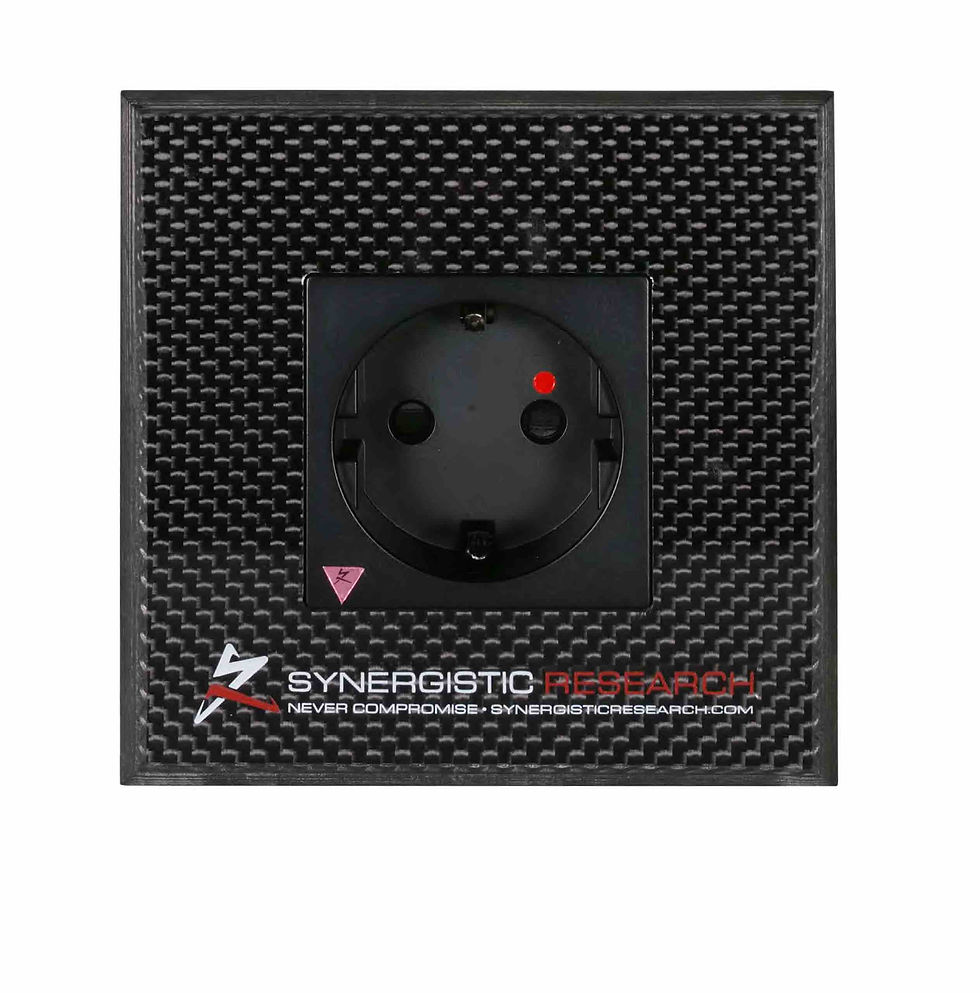
Power delivery does not begin with the amplifier’s power cable or the power strip. It begins at the wall outlet itself.
The Synergistic Research Pink UEF Outlet applies Synergistic Research’s UEF concept at the interface between the building’s electrical installation and the Hi-Fi system. According to the manufacturer, the outlet combines UEF treatment with a specialized high-voltage conditioning process intended to improve conductivity and resonance control while lowering the system’s noise floor.
From the perspective of system-based Hi-Fi tuning, this approach is understandable: If the power supply, power strip and power cables are regarded as one continuous chain, the wall outlet should not be considered completely separately from the components that follow it.
The Pink UEF Outlet is therefore not a typical accessory that can simply be placed anywhere in the room. It is a targeted intervention at a central point in the power-delivery chain.
As with all power-related Hi-Fi tuning measures, the expected result depends on the existing electrical installation, the connected components and the overall system. It should therefore be regarded as one element within a broader power and system-tuning concept rather than as a universal solution.
The installation of a wall outlet must be carried out by a suitably qualified electrician. Work on the building’s electrical installation should never be undertaken without the necessary professional expertise.

The Tranquility Base Carbon and Tranquility Pod Carbon take a more comprehensive approach than the ECTs and GCTs. While ECTs and GCTs are positioned more selectively at specific points, these products are designed to influence the electromagnetic environment around an entire component.
Synergistic Research describes the Tranquility Base Carbon as an active isolation base featuring EM Cell technology, intended to condition electromagnetic fields within the component placed on top of it. The base combines electromagnetic field control with mechanical isolation.
The Tranquility Base Carbon combines a rigid billet-aluminum chassis, a carbon-fiber top, an active UEF EM Cell and Ground Plane technology. It is supplied with a power supply and MiG 4.0 isolation footers.
The Tranquility Pod Carbon applies a similar principle in a smaller and more flexible format. It can be positioned directly above or below an important component. Suitable candidates may include a DAC, streamer, phono stage, preamplifier or amplifier. According to Synergistic Research, the Pod Carbon combines an active EM Cell, UEF technology, a Ground Plane and a carbon-fiber chassis.
This makes the Pod Carbon particularly versatile when there is not enough space for a full-sized isolation base or when different components are to be tested individually.
Products of this kind can be especially interesting in an already well-balanced Hi-Fi system. At this stage, the goal is no longer to correct an obvious setup problem, but to explore the final steps towards greater calm, scale, clarity and inner coherence.
The Tranquility Base Carbon can be used as a support platform beneath important components, while the Tranquility Pod Carbon can be positioned more flexibly around individual devices.
For an already highly refined Hi-Fi system, these products can represent a particularly far-reaching step in system tuning. How pronounced the change will be depends on the existing system, the listening room and the component being treated.
As with all system-tuning products, we recommend introducing one measure at a time and listening carefully with familiar recordings. This makes it easier to determine whether the result genuinely suits the character of your system.

The Synergistic Research Carbon Tuning Discs are among those products that allow you to explore the character of a system in a particularly playful way.
The small discs are positioned on selected cables and are intended to interact with the electromagnetic environment surrounding the respective conductor. Synergistic Research describes the Tuning Discs as UEF-treated elements that can be used on cables.
Adjusting the sound of a cable or the sonic signature of an audio system to your own preferences? Yes – this is precisely where things get interesting.
The Carbon Tuning Discs are available in different versions, including Purple and Gold. Based on our own listening experience, we would describe their sonic character as follows:
For us, the Purple version tends to move the presentation towards greater calm, coherence and smoothness, while the Gold version brings more openness, clarity and harmonic overtones to the sound.
Synergistic Research recommends experimenting with both versions and combining them carefully. The manufacturer describes the Gold discs as contributing richer harmonic texture and liquidity, while the Purple discs are intended to enhance clarity, extension and spatial information.
The key is finding the right position and balance for your own system. As with seasoning, a little experimentation can go a long way – but it is also possible to overdo it. The Carbon Tuning Discs are powerful system-tuning tools and should therefore be introduced step by step. If you've already chosen a high-quality speaker cable – for example with the help of our
Speaker Cable Guide or our Silver vs. Copper Speaker Cable comparison – the Carbon Tuning Discs are the ideal tool for that final sonic fine-tuning.

Cable risers and cable lifters are initially viewed with skepticism by many Hi-Fi enthusiasts. They are certainly a matter of personal taste from a visual perspective, but in a carefully assembled system they can make an interesting audible difference.
A cable lying on the floor is not completely neutral. It can absorb mechanical vibrations, couple to the supporting surface and, depending on the type of floor, pick up static charge and electromagnetic influences.
The Synergistic Research UEF Performance Elevators lift the cables away from the floor and combine this mechanical change with an integrated SR tuning module. This not only changes the cable routing, but also incorporates the electromagnetic environment around the conductor into the tuning concept. Synergistic Research states that the integrated HFT resonator interacts with the cable’s electromagnetic field and that the elevators are intended to improve aspects such as low-frequency control, midrange clarity, high-frequency extension and soundstage scale.
With this type of cable tuning, the aim is not necessarily to raise every cable in the room as high as possible. It makes more sense to begin with the most important and longest cables. Power cables, speaker cables and sensitive analogue or digital interconnects may be particularly interesting starting points.
As with all Hi-Fi accessories, the distance, position and surrounding environment can influence the listening impression. That is why a step-by-step approach is worthwhile.
We recommend starting with a small number of risers and listening carefully before expanding the setup. This makes it easier to determine whether the change actually benefits the system or whether a different position would be more suitable.
In what order should you try Hi-Fi tuning?
There is no fixed order that applies equally to every system. Nevertheless, it has proven useful not to change several things at the same time. If you install new power cables, component footers, ECTs and room-acoustic products all at once, it becomes very difficult to determine which product has influenced the result.
A good starting point is to check the basic setup first. Loudspeaker placement, listening position, cable routing, power and signal cables, as well as possible ground loops, should be considered before moving on to more specialized tuning measures. Speaker and listening-position adjustments are often the most sensible first step because they can have a fundamental influence on the soundstage and room interaction without requiring any new accessories.
We would therefore proceed roughly as follows:
Check the basics first: loudspeaker placement, listening position, cable routing, power and signal cables, and possible ground loops.
Look at the central power and signal supply: power cables, interconnects, speaker cables, power strips and the most important components.
Try targeted measures: ECTs, GCTs and UEF Performance Enhancers.
Address mechanical resonances: MiG 4.0, SRX Footers or a Tranquility Base Carbon.
Refine the listening room and cable environment: HFT Speaker Kit, Carbon Tuning Discs and UEF Performance Elevators.
This sequence is not set in stone, but serves as a useful point of reference.
In a streaming system, the network section may deserve attention right at the beginning. In an analogue setup, the phono stage, grounding or mechanical isolation may offer the greater potential for improvement.
The important thing is to make only one change at a time and listen with recordings you know well. This gradually creates a clear picture of which measures genuinely move your own system forward.
A short listening diary can also be helpful. Note down the component, product, position and listening impression after each change. This makes it easier to return to a previous setup and prevents the different impressions from becoming blurred together.
The aim is not to use as many Hi-Fi accessories as possible, but to find the combination that best suits the system, the listening room and your personal taste.
What matters more in Hi-Fi tuning: accessories or room acoustics?
Room acoustics should never be completely overlooked when tuning a Hi-Fi system. A loudspeaker can only reproduce what ultimately reaches the listening position.
Reflections, resonances and unsuitable loudspeaker placement can therefore influence the sound more strongly than a single accessory.
Hi-Fi accessories cannot replace sensible loudspeaker placement or fundamental room-acoustic treatment. They can, however, further refine a system that is already properly set up. Products such as the HFT Speaker Kit offer a targeted way of responding to the acoustic characteristics of a particular room without having to rebuild or redesign the entire space.
The Synergistic Research HFTs are positioned within the area of acoustic transducers and room tuning. The manufacturer describes them as miniature acoustic processors that interact with the acoustic and electromagnetic energy in the listening environment. When placed strategically around the speakers and throughout the room, they are intended to influence spatial information, timing and tonal clarity.
This does not make the HFT Speaker Kit a substitute for basic acoustic principles. It is better understood as a flexible form of targeted room tuning that can be adjusted to the room, the loudspeakers and the listener’s personal preferences.
The most sensible approach is therefore not to choose between accessories and room acoustics as if they were competing solutions. First establish a solid foundation with correct loudspeaker placement, a suitable listening position and basic control of reflections and resonances. After that, Hi-Fi accessories and targeted products such as the HFT Speaker Kit can be used to further refine the soundstage and overall presentation.
Is Hi-Fi tuning with Synergistic Research worthwhile?
That cannot be answered universally, because the result depends on the existing system, the listening room, the component being treated and your personal preferences. Synergistic Research offers a broad range of system-tuning products for different areas, including electromagnetic field control, grounding, room acoustics, cable tuning and mechanical resonance control.
From our experience, the particular appeal lies in the fact that many of these measures can be tried step by step. You do not have to change the entire system at once. Instead, you can begin at a clearly defined point and gradually work your way through the system.
This may involve starting with ECTs or GCTs, experimenting with HFTs in the listening room, using Carbon Tuning Discs on selected cables or trying MiG 4.0 footers beneath a sensitive component.
Independent listening reports also describe audible changes in areas such as soundstage size, focus, bass control, clarity and noise-floor perception. At the same time, such reports are listening impressions rather than universally applicable measurements, which is why the results should always be assessed in the context of the individual system.
In our view, Synergistic Research is especially interesting for listeners who enjoy exploring their system in detail and who are prepared to experiment with placement, combinations and different tuning approaches.
It is not necessarily the right choice for someone looking for a single universal upgrade with a guaranteed result. Hi-Fi tuning is not a replacement for a well-designed system, suitable loudspeaker placement or sensible room acoustics.
The best approach is to start with one clearly defined measure, listen with familiar recordings and decide whether the result genuinely benefits your system.
For us, the answer is therefore yes: Synergistic Research Hi-Fi tuning can be worthwhile, particularly when it is approached as a carefully structured system-tuning process rather than as a collection of isolated accessories. The goal is not to use as many products as possible, but to find the combination that best suits your system, your room and your personal taste.


Comments