Why Tube Microphone Preamps and Saturation are essential for professional Recordings


Do audiophile fuses make a difference?


High-End Hi-Fi Grounding Cables for Audio Systems: Improve Sound Quality and Safety
For high-quality HiFi and high-end systems, dedicated audio or tuning fuses are ideal, as they are optimized for low contact resistance and stable electrical connections. These fuses are not just protection devices; they sit at a crucial bottleneck in the flow of electrical potential and can influence microdetails, spatial imaging, soundstage width and depth, as well as the three-dimensional detachment of the sound from the loudspeakers.
Audiophile fuses can make an audible difference depending on the system, mains quality and overall setup, especially in terms of fine detail, transients, spatial imaging and tonal colour. Because the fuse is a potential bottleneck in the power path, an optimized design with better materials and contacts can improve the transmission of delicate musical information, enhancing microdetail, stage size, localisation precision and a more holographic, three-dimensional presentation.
The “T” marking stands for “time lag” or “slow-blow” and refers to fuses that can tolerate short inrush current peaks before they blow. This slow characteristic is very useful in many amplifiers and powerful components because it protects against real fault currents without tripping at every switch-on surge, while still defining a stable, predictable bottleneck in the power path.
The “F” marking stands for “fast” and designates fuses that blow very quickly once the rated current is exceeded. These fast-acting types are mainly used in sensitive or lower-power circuits where components must be protected against even short overcurrent peaks, and they also form a critical point in the power path where the quality of electrical conduction can affect the final sonic result.
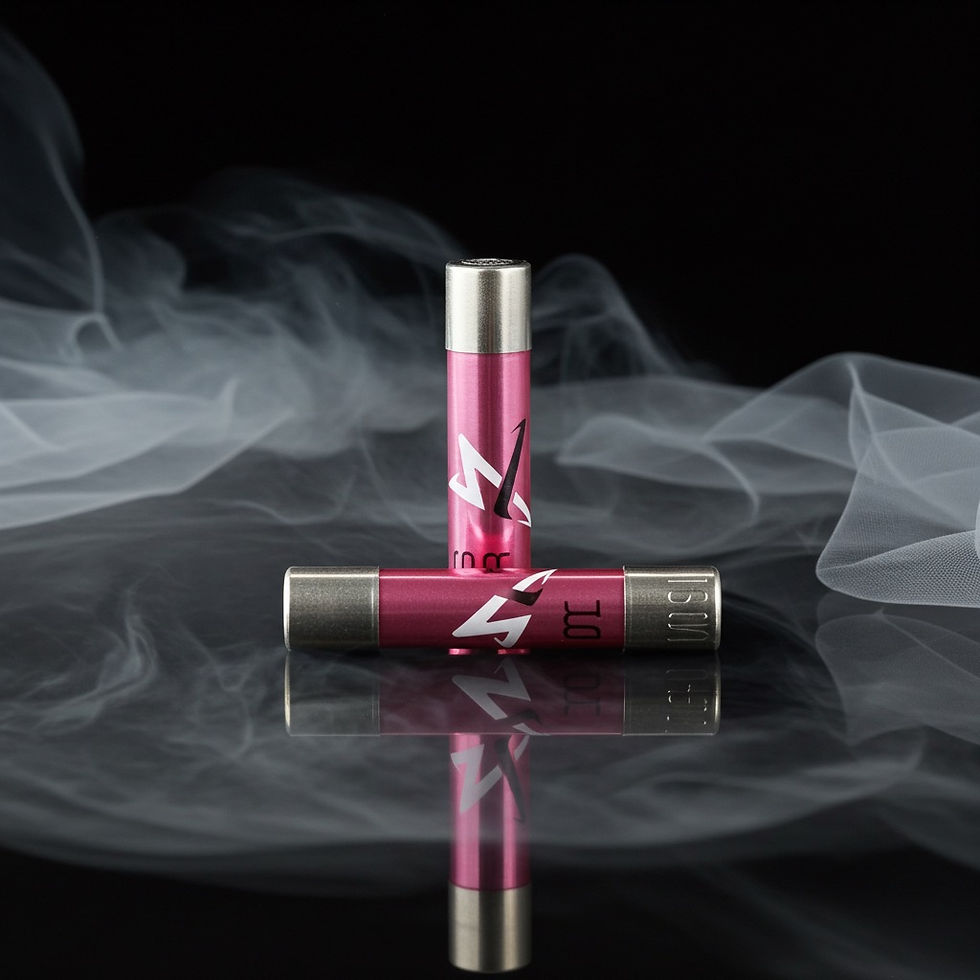
From a tuning expert perspective, the Synergistic Research Master Fuse ranks among the very best choices, as it clearly outperforms many conventional and audiophile fuses in terms of resolution, spatial imaging and musicality. Its developer, Ted Denney, has invested extensive effort and know-how into materials, construction and treatment, with the goal of minimizing the bottleneck effect in the power path and unlocking more microdetail, depth and three-dimensional soundstaging from high-end systems.
Fine fuses can be differentiated by size (for example 5×20 mm or 6.3×32 mm), by their time-current characteristic (slow-blow “T” or fast “F”), and by materials and construction. In the audiophile sector, you will find versions with special alloys (such as silver/gold), ceramic instead of glass bodies, and additional treatments like cryogenic or “quantum” processing, all intended to further reduce contact resistance and negative effects on current flow.
Yes, Synergistic Research fuses have a direction (polarity) that is important for achieving optimal sound quality. The direction is often indicated by the writing on the fuse (for example, from the S in “Synergistic” to the H in “Research”), meaning the current should flow from left to right. In addition, the fuse requires a burn‑in period of about 200–300 hours to reach its full sonic potential.
How to identify the correct direction:
Writing direction: The labeling (e.g., "Synergistic Research") indicates the flow direction — current should go from left to right, from the “S” to the “H.”
Listening test: If you’re unsure, insert the fuse in both directions and listen. The correct direction will sound more detailed, open, and natural.
Polarity tester: Use a phase tester to check the correct orientation of your connected devices — this also applies to the fuse.
Important notes:
Burn‑in time: The first 200–300 hours are crucial for the fuse’s sound development.
Sound differences: When oriented correctly, the sound becomes more detailed, clear, and spatial.
Function: In case of a short circuit, the fuse will still blow even if installed in the wrong direction — but you’ll lose the sonic advantage.