


Do audiophile fuses make a difference?


For hardcore hi-fi enthusiasts, this little piece of audio tuning with its almost mythical sonic improvements is already a sacred ritual, while for everyone else it is more like a complete mystery: replacing standard mains and device fuses with high‑quality, dedicated hi‑fi fuses.
Convinced tuning fans report major effects such as improved depth layering, micro‑detail and a more holographic soundstage – just to name a few of the attributes praised when describing the changes brought about by this kind of sound tuning.
Why the fuse in your hi-fi system matters
The role and construction of a standard fuse
But let’s start at the beginning. As protection against short circuits and lightning strikes, every hi‑fi component is equipped with a small fuse at the inlet of the IEC socket. The fuse itself consists of two contact points with a thin wire in between. This wire is extremely thin and will melt in the event of a short circuit, thereby protecting the device’s electronics from damage.
Typically, the kind of fuse used in consumer electronics and hi‑fi gear costs around 20 cents apiece – hardly what you would call high‑end, right? It is worth considering that the entire electrical potential has to squeeze through this tiny wire in order to supply your device with power.
Electricity is more than “water in a pipe”
For decades, people stubbornly clung to the idea that electricity behaves like water in a pipe: it goes in at one end, comes out at the other, and after a couple of meters of cable the story is basically over. Modern physics looks at this very differently – and that is exactly what makes the discussion about fuses so interesting. What really matters is not some slow “flow” of electrons, but the propagation of the electrical field along the conductor. This field reacts sensitively to every imperfection in its path, to every component that narrows, deflects or otherwise influences the current path.
The fuse as a bottleneck in the power path
The critical point at the IEC inlet
Let’s assume you are using a high‑quality power strip and a proper hi‑fi power cable to feed your amplifier. From that perspective, the one point where the current still cannot flow completely unimpeded is the transition into the device’s socket, right where the fuse sits.
Imagine optimising your power delivery with good cables and a premium power strip, only to then send everything through a basic 20‑cent standard fuse. This is exactly where the bottleneck is created: here, the quality of the fuse determines how “cleanly” the electrical field arrives inside the component – and therefore what kind of foundation your hi‑fi system can have in terms of sound.
Distortions and electromagnetic fields around the fuse
If the fuse is of mediocre quality, the transitions into and out of the fuse introduce distortions that affect the entire internal circuitry of the hi‑fi component. In addition, just as in every part of a hi‑fi system, an electromagnetic field is created here, which can significantly influence all surrounding parts, devices and cables.
In fact, such electromagnetic fields exist everywhere in a hi‑fi system. It does not matter whether a component is in the signal path or not – in the end, even a part that does not directly carry audio will always influence another part that does carry audio. All components in an audio system are therefore in constant interaction with one another. This is precisely the kind of electromagnetic disturbance that Synergistic Research's Ground Circuit Tuning devices (GCTs) are designed to address. Affixed with a dedicated mounting paste directly next to the IEC inlet, right where the fuse sits, GCTs passively calm the electromagnetic field radiating from this exact bottleneck — complementing what an audio-grade fuse already achieves at the component level.
Your personal electromagnetic “cocktail”
When the sound feels veiled and sticks to the speakers
You can imagine these electrical fields as an electromagnetic cloud forming in many different places. If you now consider that every system is tuned very individually, and that these electromagnetic fields and their radiation always differ and fluctuate, you have to conclude that each system has its own personal electromagnetic cocktail.
Unfortunately, this is not exactly the pleasant kind of cocktail: it leads to a veiled sound, the music seems to stick to the speakers, the presentation feels restless and the loudspeakers do not really lock in and form a coherent soundstage.
What you would much rather have is a really good cocktail together with a soundstage that opens up freely in the room – maybe with just a slight buzz instead of a sonic hangover.
Audio‑grade fuses as a powerful tuning tool
How audio‑grade fuses calm the electrical environment
Back to audio‑grade fuses. One way to counter this problem is to influence the electromagnetic fields described above. In physics it has long been known that electrons move far too slowly to be primarily responsible for clean power transmission. What really matters is the electrical potential, which travels at the speed of light.
Modern, carefully engineered audio‑grade fuses aim precisely at this point. They are designed so that this bottleneck is shaped in a way that makes the electrical environment inside the device calmer, more stable and less disturbed. From an audiophile perspective, this is not about magic, but about a logical consequence: if the very first component in the power path is built to a high standard, this can affect the entire behaviour of the component – and ultimately the sound you hear.
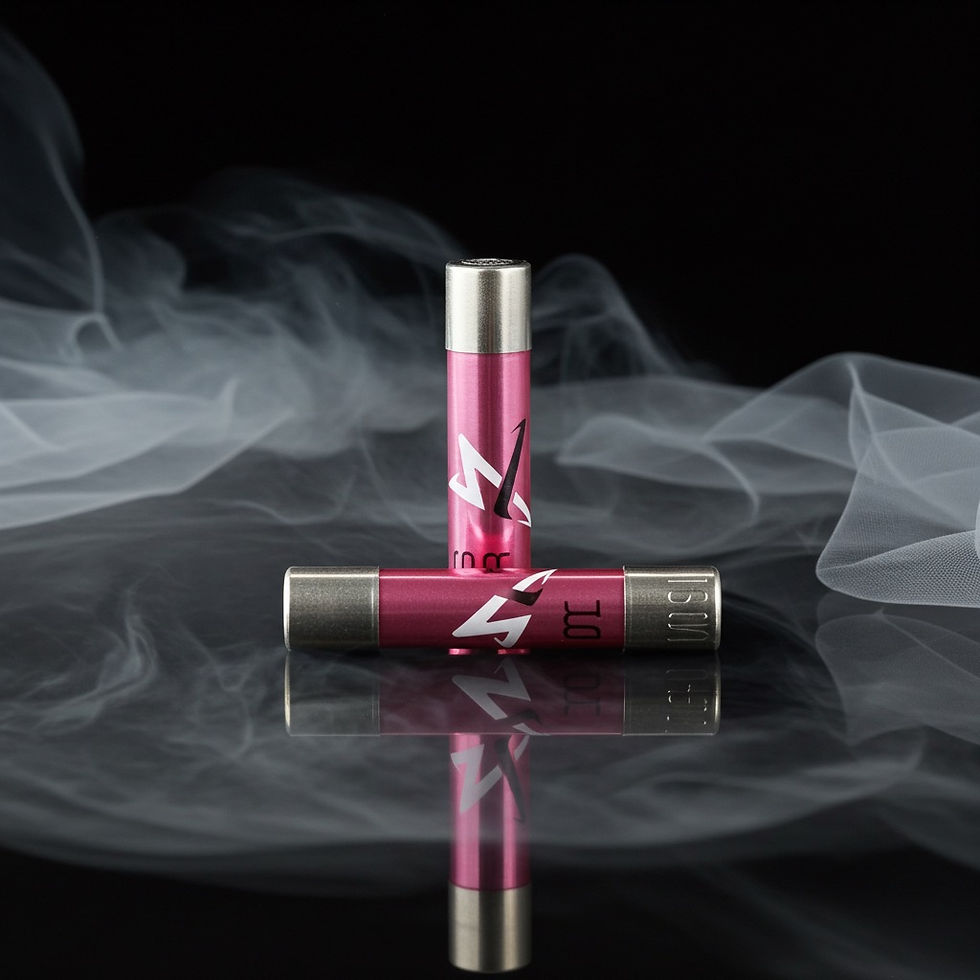
From long‑term experience in audio and video tuning, it almost seems negligent when hi‑fi manufacturers do not give any real consideration to using a high‑quality fuse in their components, even though it is so crucial – or is it not?
The focus should always be on a truly holistic view of hi‑fi components – in other words, on the best possible sound reproduction. Manufacturers who ignore the topic of fuses in their product development are missing out.
If that is the case (and it often is), there is nothing left for the dedicated audiophile but to try this kind of audio tuning personally – and that comes with a very high fun factor.
Where to start with audiophile fuses
Key positions for upgrading fuses in your system
There are many possible starting points, depending on what you want to improve. The key is to concentrate on the most important components first, before going back through the system and identifying which fuses represent real leverage points for optimisation.
A typical starting point would be:
Power supplies and amplifiers (integrated amps, power amps, preamps), because they shape the sonic foundation of your entire system.
Source components like DACs, CD players or streamers, which provide the input signal and benefit greatly from a clean power supply.
Only then move on to peripheral gear such as phono stages, active speakers or separate power conditioners and power strips to further refine the overall presentation.

This way, you can work your way step by step towards the positions in your system where high‑quality audio fuses offer the greatest impact.
Which audiophile fuse is the right one for you?
Experimenting with different brands and sonic signatures
The answer is: experiment, experiment and experiment again, because the effects and sonic signatures of different brands are clearly audible.
Ted Denney has poured his many years of expertise as a physicist into the development of his fuses at Synergistic Research, and these in turn form the basis for various in‑house components.
The special features of the Synergistic Fuses include their unique UEF technology (Uniform Energy Field), the use of high-quality materials such as graphene and a silicon oxide filling, as well as a three-stage treatment of all audio fuses using a special 1,000,000-volt high-voltage Tesla device, which is used to burn in the fuses.
The contacts are additionally coated with brass and nickel.
Speaking from personal experience, many different brands have been tested in high‑quality hi‑fi systems, from 7‑euro solutions all the way up to 640‑euro fuses.

Synergistic Research Pink vs. Master Fuse
Why the Synergistic Research Pink Fuse is a strong recommendation
A very frequent recommendation is the Synergistic Research Pink Fuse. At 265 euros it is certainly not cheap, but it is very well and cleverly designed and, compared with the now discontinued Black, Blue, Red, Purple and Orange series, clearly improved thanks to new insights gained in the Synergistic Research lab.
The Synergistic Research Master Fuse – use with care
For anyone who is not afraid of a bigger investment, or who has already had good experiences tuning their system with premium fuses, the Synergistic Research Master Fuse is highly recommended.
However, take care: 1–2 per system at carefully chosen positions are usually enough.
Too many of them can (!) actually be counterproductive – in that case, it is better to use the Pink Fuse more widely.
We've recently had customers giving us positive feedback, who were delighted by more than 3 Master Fuses and really liked the overall improvement that transformed their listening.
The newly launched Synergistic Research Holographic Fuse – 3D soundstage like never before
Just launched in July 2026, the Synergistic Research Holographic Fuse is the result of decades of research and development at Synergistic Research, now combined with modern AI‑assisted design.This fuse is engineered to block critical interference in the MHz and GHz frequency ranges, creating a holographic 3D soundstage yet unheard in audio fuse design. In systems that are already well‑matched and carefully powered, the Holographic Fuse can take spatial imaging, depth layering and low‑level detail to a level that goes clearly beyond what earlier generations of audiophile fuses could offer.
Burn, burn, burn, little fuse!
Does an audiophile fuse need burn‑in?
Absolutely yes. An audiophile fuse – and the entire audio system around it – needs proper burn‑in time to settle and to reveal its full sonic potential.On top of that, you also have to adapt to the new sonic signature, because our hearing always evaluates sound in comparison and learns over time.
How long does an audio fuse take to burn in?
As a rule of thumb, give any new audio fuse at least 48 hours of continuous play before taking your first serious judgment – anything earlier is just a snapshot.For the Synergistic Research Pink Fuse, many listeners report that the sound keeps opening up and stabilising well beyond that point, with meaningful changes happening up to roughly 100–200 hours of break‑in time.With the Synergistic Research Master Fuse you should expect an even longer conditioning period: here, soundstage, low‑noise performance and micro‑detail tend to lock into place over roughly 200 to 300 hours of burn‑in.
During this burn‑in period, it is completely normal that the sound goes through several phases – from “wow‑effect” in the first hours to a slightly edgy or nervous presentation, before the system calms down and the fuse starts to deliver a more coherent, holographic soundstage.Especially in highly optimised systems, it makes sense not to constantly swap fuses or tweak settings during this time, but to simply play a wide range of music and revisit your impressions after a few days or weeks.
Once the burn‑in is done, you’ll have a much more reliable picture of whether the Pink Fuse or the Master Fuse really fits your system, your taste and where a fuse upgrade offers the biggest sonic leverage.
Conclusion: audio‑grade fuses as a real hi‑fi tuning insider tip
In summary:
Yes, high-quality audio and device fine fuses can audibly enhance the dynamics, sound details, and spatiality of your hi‑fi system – a real insider tip for demanding hi‑fi tuning!
Enjoy testing it out! If you'd like to explore additional ways to tame electromagnetic interference around your components, our Guide to Hi-Fi Tuning with Synergistic Research covers complementary tools like GCTs, ECTs and HFTs. Visit our audio fuses section, to see our selection also.


Comments